
Interest Rates Are More Normal Than Risky
One of the biggest market developments in 2026 has been the sharp rise in global interest rates. The U.S.-Israel war against Iran triggered a sharp increase in oil prices in February. Neither the war nor oil prices have since abated, causing inflation to remain stubbornly sticky. Not surprisingly, the global rise in inflation spawned an initial surge in global interest rates, which has then continued to escalate in recent months.
The rise in interest rates has been seen at both the short and long end of the yield curve. Markets in most major economies have swung from expectations of rate cuts at the beginning of 2026 to now pricing in policy rate hikes. As of September 2026, U.S. markets were expecting +37 basis points (bps, 0.37%) of rate hikes by the end of 2026 as opposed to rate cuts of -59 bps at the beginning of the year.
Long-term interest rates have also risen in tandem across the globe. The U.S. 10-year Treasury yield rose by 0.85% in the third quarter alone and by 1.13% in the first nine months of 2026. As yields climb above 5%, long-term Treasury bonds are trading at levels not seen in more than 20 years.
Investors are now concerned about the sharp rise in interest rates at many different levels. The annual net interest payment on the U.S. national debt surpassed $1 trillion in August for the first time ever; it now accounts for almost 20% of all federal revenue collections. Investors worry that the current government debt burden will soon become unsustainable. Mortgage rates have risen well above 7%, and an already-strapped U.S. consumer may eventually buckle under the weight of higher borrowing costs. As goes consumer spending, so goes the U.S. economy. And finally, higher interest rates can take a toll on other risky assets. They make bonds a more attractive asset class, which in turn compresses stock valuations on a relative basis.
While a lot of academic literature is devoted to decomposing nominal interest rates, the analytical framework for estimating their components can become complex, less tractable and lack intuition. We discuss the key drivers of nominal interest rates more qualitatively here and offer our assessment of their relative importance in pushing rates higher. We also highlight where our views may differ from those of the market and offer a potential opportunity of mispricing.
Drivers of Nominal Interest Rates
In the simplest configuration, nominal sovereign interest rates can be considered to be comprised of two main components: inflation expectations and a real yield. Inflation expectations in turn also have two elements: expected inflation and an inflation risk premium. The inflation risk premium compensates bond investors for future inflation risk. As an example, inflation risk exists because different growth trajectories in the future may produce different inflation outcomes.
The real yield also has two components: the expected level of future real short rates and a real term premium. The path of future short rates is mainly influenced by Fed policy in response to changes in short-term inflation and real GDP growth rates. A related metric that determines future policy rates is the implicit neutral rate r*, defined as the equilibrium policy rate, which achieves stable employment and stable prices without proving to be expansionary or contractionary.
The real term premium offers investors compensation for bearing duration risks as they lock money up for longer periods of time. These risks can appear in many ways e.g. increased supply to manage a deteriorating fiscal outlook with large deficits, heightened geopolitical tensions that threaten commodity prices, policy-induced shifts in aggregate demand, or “crowding out” effects from competing demand for capital.
Also, financial markets rarely remain in equilibrium at all times and less so during volatile periods. We allow some room for mispricing by introducing a third general factor called “structural imbalances,” where supply and demand mismatches create price dislocations. A classic example here is the ability of central banks to alter the term premium simply by disproportionately buying or selling long-term bonds. We operate within the broad framework of nominal bond yields defined below.
Nominal Bond Yields = Function of (Inflation Expectations, Future Short Rates, Real Term Premium, Structural Imbalances)
Inflation Expectations
One of the more important innovations in the history of the U.S. capital markets was the introduction of Treasury Inflation-Protected Securities (TIPS) in 1997, which tied the principal and interest of sovereign debt to inflation. Investors bear unexpected inflation risk when they own traditional bonds. On the other hand, TIPS generate a “real” rate of return net of CPI (Consumer Price Index) inflation.
With some minor simplifying assumptions, we can think of the TIPS yield as a good proxy for the real yield. By extension, the spread between nominal bond yields and TIPS yields, known as the breakeven inflation rate, becomes a good proxy for inflation expectations.
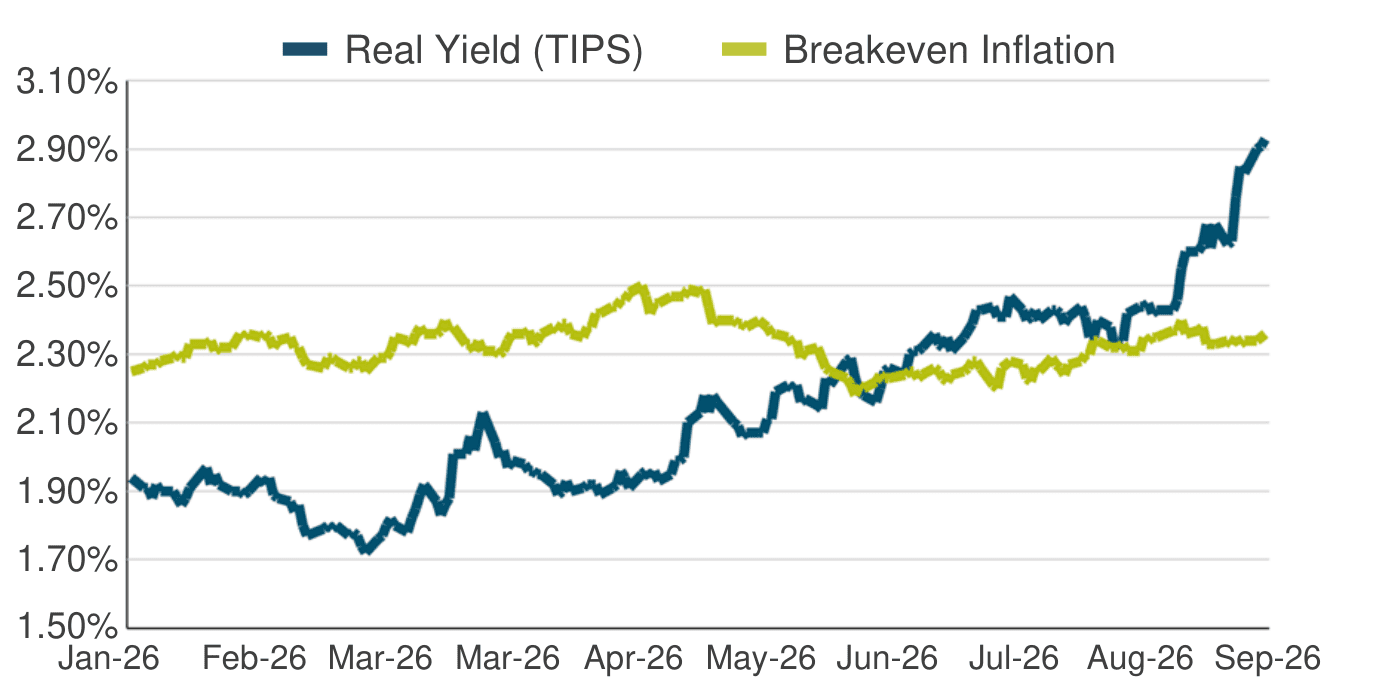
We show these proxies for inflation expectations, defined as breakeven inflation above, and real yields for the 10-year Treasury bond in Figure 1.
Figure 1: Real Yields, Not Inflation Expectations, Drive Rates Higher
Source: U.S. Department of the Treasury. As of September 30, 2026.
Nominal bond yields are priced on 10-year inflation expectations, not on where inflation has been over the last 1, 3 or 6 months or where it will be over the next 1, 3 or 6 months. Despite wild gyrations in contemporaneous measures of inflation, long-term inflation expectations have remained remarkably well-anchored. The 10-year breakeven inflation rate (green line) in Figure 1 has remained range-bound between 2.2% and 2.5% in 2026 and stood at 2.35% at the end of September. The market has remained steadfast in its conviction that today’s high inflation is unlikely to be a decade-long problem. It believes that the current war-and-tariff-induced surge in inflation will subside in the future and leave 10-year inflation just above the Fed’s stated target of 2%.
Figure 1 also shows that most of the increase in the 10-year bond yield during 2026 comes from a rise in real yields (navy line). The 10-year Treasury bond yield has risen by more than 1.1% through September, and more than 90% of that increase has come from a rise in the real yield.
While inflation expectations have held steady so far, we remain alert that they may yet become unanchored in the future if inflation doesn’t subside. We know the Fed has already responded to recent high inflation in a move that alters the path of future short rates.
Future Short Rates
Markets were initially hopeful that the war with Iran would be short-lived and that the related spike in oil prices and, therefore, inflation would be transient. In reality, neither has happened and calls for a more restrictive Fed policy have become more strident.
Fed Chairman Kevin Warsh committed to a vigilant and proactive approach in fighting inflation soon after taking office in May. The Fed then hiked rates by 25 bps in September in the face of persistently high inflation.
While the beginning of a new tightening cycle is a popular course of action, we share two considerations that give us some pause for early reflection.
- We wonder how well the current drivers of inflation can be tamed by higher policy rates.
- We are intrigued by how bond yields initially reacted to the start of the tightening cycle.
Likely Efficacy of Fed Tightening
A restrictive monetary policy is most effective in slowing an overheating economy through demand destruction. However, we see today’s inflation problem as a severe supply side shock, not as a result of excessive consumer demand. The war with Iran has created a supply disruption in oil by constricting its flow through the Strait of Hormuz. We are hard-pressed to see how higher short rates will resolve either the geopolitical tension or the commodity bottleneck; oil prices won’t come down just because the Fed hikes rates.
We acknowledge that there is one strong demand dynamic that is actually contributing to higher inflation. The relentless AI capex spending cycle has significantly increased the cost of semiconductors and memory chips. Higher memory costs are now making inflation more pervasive as they make phones and other electronic devices more expensive.
However, we are again unsure how higher short rates will curb this demand for continuous AI investments. The sheer size of spending on AI infrastructure has already resulted in higher debt burdens and higher borrowing costs. Yet, this demand for AI infrastructure has so far proven to be largely rate-insensitive. A further 0.5-1.0% increase in borrowing costs is unlikely to dent the pursuit of 20-30% returns on investment from continued spending.
On the other hand, a real risk is that much higher policy rates will compromise consumer spending and steer the U.S. economy towards the undesirable destinations of stagflation or, beyond it, a recession.
We balance out doubts on the efficacy of current Fed policy with observations in support of the last rate hike. We recognize the need to keep inflation expectations in check. Inflation expectations are amorphous in concept and hard to anchor psychologically. They are simply created in people’s minds from a continuous subjective assessment of the central bank’s credibility in controlling long-run inflation. Just like in any other relationship, this trust is hard to build and easy to lose.
The recent Fed decision to hike rates lends credibility to the Fed’s stated vigilance in dealing with months of sustained inflation. It also comes at an opportune time to validate Fed independence in the face of perceived political interference.
We maintain an overall position that the current backdrop may not be as conducive for Fed tightening to tame inflation. We also believe excessive tightening may actually backfire and create an economic slowdown without materially lowering inflation.
Fed Tightening and the Yield Curve
There is a conventional playbook for the effects of Fed tightening on the yield curve. Higher policy rates aim to lower price pressures by destroying demand. Slower economic growth is often the price paid to get lower inflation. Here is how the sequence of events typically unfolds.
Fed tightening causes the short end of the yield curve to rise. The prospects of lower inflation and slower growth described above then cause rates at the long end of the yield curve to decline. This “flattening” of the yield curve is normally a precursor to an economic slowdown. If the Fed tightens excessively to “over-destroy” demand, this flatter yield curve actually inverts as long rates drop below short rates. History tells us that an inverted yield curve is generally a precursor to an economic recession.
As Fed tightening became more likely during the third quarter, it was quite unusual to see long-term rates actually going up instead of going down. We also know from the earlier discussion that inflation expectations did not go up, so that cannot explain the continued rise in long rates in the third quarter. At times, it even felt incongruous and irrational to see bond yields rising in knee-jerk fashion to intraday spikes in oil prices.
We cannot yet suggest errant mispricing as a convenient explanation because we still have other fundamental drivers of higher bond yields to discuss. We look at changes in real growth rates next and then devote a whole section to the topic of the real term premium.
Higher Secular Growth
The huge investment in AI infrastructure and resulting productivity gains create an important path to a higher real yield. We have held the view for a while now that AI-led productivity gains will lift U.S. potential GDP growth closer to 3% in the future from its meager sub-2% pre-Covid level.
We believe that markets have started to price in a higher secular level of real growth in both short and long interest rates. Markets may also be anticipating the possibility of a higher neutral rate r* for the U.S. economy. If the higher expected real GDP growth rate does come bundled with a higher inflation level, the neutral policy rate that keeps the economy balanced may also be higher.
We were clear at the beginning of 2026 that the neutral rate r* was likely to be higher, at around 3.0% from its 2.0-2.5% pre-Covid level. At this early stage, we are not ready to buy into the market speculation of a new neutral rate r* of around 3.5%, perhaps even 4.0%.
We believe instead that AI-driven growth will be disinflationary in the long run and will not push the neutral rate r* materially higher. This divergent view leads us to believe that there is more room for bond yields to drift lower than to move higher in the long run.
We move from the fundamental topics of inflation expectations and growth to the more subjective forces that drive the perception of risk in government bonds and cause investors to demand a commensurate risk premium.
Real Term Premium
There is no pre-defined or a priori set of factors that definitively make up the real term premium. We identify a few factors that we believe are weighing on investors’ minds today and discuss them briefly.
Fiscal Risks
We believe that fiscal risks associated with a large, and seemingly deteriorating, government debt burden are by far the biggest driver of any change in the real term premium for Treasury bonds.
The catalyst for heightened concern came in the third quarter when the national debt crossed $40 trillion for the first time ever, and the net interest payment on that debt breached the $1 trillion threshold for the first time ever.
We appreciate that both these numbers are large and potentially alarming. But we modestly suggest reframing the relevant metrics for discussion because financial markets rarely react to just the level of a factor; they focus instead on the trajectory of the variable.
The debt burden for the government sector is typically measured as a percentage of GDP. While the national debt grew from about $38.5 trillion at the end of 2025 to $40 trillion in August 2026, U.S. GDP also grew from around $31.5 trillion to almost $33 trillion over the same time period. As a result, the debt-to-GDP ratio has remained largely unchanged in 2026.
While $40 trillion made for dramatic headlines, the debt picture hasn’t changed materially in 2026, when the real term premium is deemed to have spiked because of a deteriorating fiscal outlook.
We recognize the topic of fiscal risks is highly charged and politically divisive. With no other aspiration than to offer a clinical economic and investment perspective, we cautiously catalog the following observations.
- The U.S. debt-to-GDP ratio has remained largely unchanged at around 120% in 2026 and over the last few years. It nudged higher by 1-2% to approximately 122% in the third quarter.
- We have pointed out previously that net of intragovernmental holdings, the so-called “debt held by the public” is below 100% of GDP. Further stripped of Fed holdings, the remaining debt held by the public is below 85% of GDP.
- If the U.S. were being singled out for uniquely excessive fiscal risks or populist policies that alienated allies and foes alike, U.S. government bond yields would have spiked up in isolation relative to a cohort of global sovereign bonds. We do not find that to be the case; almost all sovereign bonds have moved up in unison across the globe.
- If U.S. government debt alone were now perceived to be significantly riskier by domestic investors, U.S. credit spreads would have narrowed as the base Treasury rate would rise in isolation relative to corporate bond yields. We do not find that to be the case either; credit spreads have actually widened instead.
We summarize our position as follows. We acknowledge that high debt burdens are not sustainable forever and cannot be allowed to grow without restraint. We do not see new meaningful information on the topic in 2026. We, therefore, do not perceive the higher level of risk in the fiscal outlook that we believe the market has priced in through September. In a contrarian setting, we believe this also bolsters the case for more downside than upside in rates beyond September.
We discuss the other drivers of the real term premium more briefly.
Changes in Aggregate Demand
A lot has been discussed about the reduced ownership of Treasury bonds by foreign holders. It is widely believed to be a consequence of the new direction of U.S. policies on topics like global trade and immigration. The sale of Treasuries by foreign owners can exert upward pressure on bond yields.
Proponents of this theory point to China’s significantly lower holdings of Treasury bonds in recent months. The numbers bear that assertion out. China’s Treasury holdings dropped below $600 billion in August from almost $700 billion a year ago. At the same time, their position in gold holdings within the foreign reserves portfolio increased significantly.
Even as China reduced its Treasury holdings, the Treasury reports that foreign residents increased their holdings in long-term U.S. securities in August by almost $300 billion. The U.K., Canada and India were among the notable countries with increased Treasury holdings in 2026. In an interesting caveat, the Treasury also added the following note to its table of data.
“The data in this table are collected primarily from U.S.-based custodians and broker-dealers. Since U.S. securities held in overseas custody accounts may not be attributed to the actual owners, the data may not provide a precise accounting of individual country ownership of Treasury securities.”
Competing Demand for Capital
We have already touched on AI as a key driver of future growth and current inflation with its insatiable spending habits. The hyperscalers that have done most of this spending so far have now reached a crucial tipping point in 2026. These hyperscalers have been highly profitable over the years and were easily able to fund their capex spending from their free cash flow. They are no longer able to do so and have now turned to the bond market to fund future spending.
Significant corporate issuance for AI infrastructure spending now competes for capital along with ongoing Treasury issuance. With a potentially finite pool of capital to tap into, there may be a natural “crowding effect” that pushes up borrowing costs for both borrowers.
We believe this dynamic is playing out as a relevant driver of Treasury bond yields.
Lack of Fed Forward Guidance
Fed Chairman Warsh has been steadfast in his decision to abstain from providing forward guidance about future policy actions. It has been held out as a better option that gives the Fed more flexibility to adjust to new incoming data as opposed to being weighed down by prior guidance.
The move has received mixed reviews. Markets always welcome greater transparency, more information and greater certainty. Instead, the prevalence of greater uncertainty around future Fed policy is now perceived by many as a new risk factor that commands an additional risk premium.
We understand this point of view but offer two perspectives as offsets to these concerns. First, the new policy does leave the Fed with greater flexibility to make new decisions based on new information instead of constantly modifying old guidance. Chairman Warsh has also more than satisfied inflation hawks with both his strong verbal commitment to be proactive in fighting inflation and also a unanimous rate hike.
We do not believe this is a meaningful driver of any increase in the real term premium.
We close out our article with a brief look at any structural imbalances that may be at play in pushing interest rates higher.
Structural Imbalances
We discuss price dislocations here that emerge in the bond market simply from temporary supply-demand imbalances.
While it is not as relevant a factor in 2026, one of the biggest forces behind the rise of the term premium and bond yields in the last few years has been a shift in Fed policy away from “quantitative easing” to “quantitative tightening.”
Quantitative easing is an accommodative monetary policy where the Fed purchases long-term bonds to mechanically lower interest rates. It did so in the aftermath of the unprecedented Covid shock to allow the U.S. economy to recover from the global lockdown. Quantitative tightening does exactly the opposite; the Fed sells long-term bonds because it no longer needs those artificially lower bond yields to support the economy.
These policy actions are a classic way in which long-term interest rates become artificially distorted through deliberate intervention.
We close out our article by highlighting a more obscure development in the mix of Treasury ownership.
Dominance of Hedge Funds
With a new high of $2 trillion in Treasury holdings and a 7% share of $28 trillion in secondary trading of Treasury securities, hedge funds now play a bigger role in Treasury markets than ever before. Beyond the sheer size, note that hedge funds are typically leveraged with additional notional exposure, hyperactive in their pursuit of the smallest return spread and extremely price sensitive.
We believe this shift in Treasury ownership from strategic long-term investors to tactical short-term traders has increased volatility in the Treasury bond market. We also believe hedge funds are more likely to exacerbate price declines and yield spikes in Treasury bonds because selling liquid Treasuries is often their first step in deleveraging when market volatility picks up.
We hope that this comprehensive review of recent activity in the bond market has been useful. Many divergent views are circulating in the market; we find ourselves in the minority position on a few of them.
Summary
The bond market is normally calmer and more placid than it has been in the first three quarters of 2026. We qualitatively disentangle some of the more nuanced and granular forces at play in the recent rise of Treasury bond yields.
- We discuss Treasury bond yields as a function of the following factors.
- Inflations expectations
- Future short rates
- Real term premium
- Structural imbalances
- Even though contemporaneous inflation has been high since March, inflation expectations have remained remarkably well-anchored. As a result, inflation expectations explain virtually none of the increase in Treasury bond yields.
- A conventional Fed tightening cycle is effective in lowering inflation by destroying excess demand. The current backdrop may not be as conducive for Fed tightening to tame inflation for two reasons.
- The current inflation problem stems mainly from a supply disruption and shortage of oil.
- Excess demand from AI capex spending has been largely rate-insensitive.
- Contrary to convention, bond yields moved higher instead of lower as the Fed began to tighten in the third quarter.
- We believe higher secular real growth fueled by AI-driven productivity gains best explains the rise in Treasury bond yields.
- We also believe that the higher growth may be achieved without a material increase in the neutral rate r* because of disinflationary productivity growth.
- We do not perceive the higher level of risk in the fiscal outlook that we believe the market has priced in through September.
- The debt-to-GDP ratio has remained unchanged around 120% for a few years now.
- All global sovereign bond yields have gone up, not just the U.S.
- Credit spreads in the U.S. have not narrowed, which would have signaled singularly risky government debt relative to corporate debt.
- Increased corporate debt issuance from the hyperscalers to fund the AI build out has contributed to the rise in Treasury bond yields.
- Hedge funds are an increasingly bigger player in the secondary Treasury market and have the potential to increase both Treasury bond market volatility and yields. Hedge funds are:
- Highly leveraged
- Hyperactive
- Extremely price sensitive
- Usual sellers of Treasuries in their first step of deleveraging
- We expect more room to the downside than the upside in Treasury bond yields beyond September because of our potential contrarian views and more muted concerns on 3 fronts.
- Inflation expectations
- Longer-term neutral rate r*
- Fiscal risks
- We seek new diversification and income opportunities in bonds and growth investments in high quality companies against the current backdrop of higher interest rates.
We remain cautious and vigilant in the midst of high volatility related to elevated bond yields and high AI capital spending levels. We acknowledge these are unusual times and bring the appropriate level of care and diligence to managing client portfolios.
Contact us to learn more about our services. [email protected] | 800.971.3660