
In a World of Disruption, Adaptation Is Essential for Survival
Thorough analysis and sound judgment are essential to navigating an increasingly complex world.
Adaptation Is Essential for Survival
New businesses are forming and disrupting established industries faster than ever before, driven by rapid advances in technology. AI, in particular, lets startups develop products, scale quickly, and challenge incumbents at an unprecedented pace. Competitive advantages that once took decades to challenge can now come under pressure in a matter of years. This era of accelerating disruption has important investment implications, creating both risks and opportunities. Investors must evaluate the resilience of established businesses while recognizing the potential of new companies challenging them.
The core of an investment portfolio should remain focused on high-quality, established companies with strong competitive advantages, sound balance sheets, forward-looking management teams, and the ability to fend off competition. It is equally important to consider complementing that foundation with fast-growing new entrants—companies with proven revenue models, large addressable markets, and the ability to scale and take market share.
While we believe in owning durable businesses for the long term, durability should not be confused with permanence. Even the best businesses must evolve, and investors must continually assess whether yesterday’s market leaders are prepared for tomorrow’s challenges. As technology lowers barriers to entry and accelerates the pace of innovation, that assessment becomes increasingly important.
The Role of Private Growth Equity
This is where private growth equity can play an important role. Select late-stage companies have moved beyond the earliest and most speculative phase of development. They may have established products, meaningful revenues, demonstrated customer demand, and large addressable markets, yet still have substantial room to grow before entering the public markets.
Our research team brings analytical rigor to this process, strengthening both our selection of venture and growth equity managers and our evaluation of direct investment opportunities. Our investment professionals are never paid to sell products. We recommend investments based on their merits and their role in advancing each client’s objectives.
A Foundation, Thoughtfully Complemented
The Core
High-quality, established companies with strong competitive advantages, sound balance sheets and forward-looking management.
The Complement
Select fast-growing entrants with proven revenue models and room to scale.
Guided by discipline. Every opportunity is weighed on quality, valuation, terms, liquidity and the family’s broader objectives.
Why Companies Are Staying Private Longer
Incentives for staying private longer are numerous. The depth of private capital markets now allows promising businesses to finance successive stages of growth without immediately turning to public markets. Remaining private can also give founders and management teams greater control, more flexibility to invest for the long term, and less pressure to meet quarterly expectations. As a result, companies increasingly enter public markets later in their development, often after a meaningful portion of their growth and value creation has already occurred.
Where Value Creation Happens
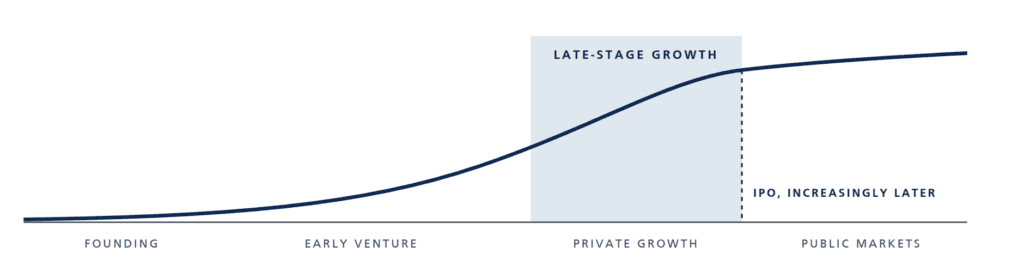
Illustrative only. A meaningful portion of growth may now occur before a company lists.
At Whittier Trust, we view private growth equity as an extension of both our clients’ portfolios and our research process. Studying private companies gives us a closer view of emerging technologies and business models challenging public-market incumbents. That perspective can inform not only what we invest in privately, but also how we evaluate the durability of the companies we own publicly. Understanding the disruptors helps us assess the businesses they seek to disrupt.
For families with multigenerational capital, access to private markets can also expand the period over which their portfolios participate in a company’s development. As businesses remain private through more of their growth, investors limited to public markets may enter later in the value-creation cycle. Select pre-IPO exposure can provide an opportunity to invest earlier and, in some cases, continue owning the business after it becomes public.
Access, With Discipline
The objective, however, is not to own private investments simply because they are private. Illiquidity, valuation uncertainty, and wide differences in manager and company performance make disciplined underwriting essential. The quality of the business, the price paid, and the terms of the investment remain paramount. Rapid growth and disruptive potential alone do not make a sound investment.
Whittier clients benefit from an approach that combines access with disciplined selection and thoughtful portfolio construction. Our investment team evaluates private opportunities alongside public-market alternatives, considering business quality, valuation, investment terms, liquidity, and each family’s broader objectives.
This integrated perspective allows clients to participate selectively in emerging companies while maintaining a diversified portfolio anchored in established businesses. For families with patient, multigenerational capital, the result is broader access to the growth economy, supported by the discipline required to manage risk.
What We Weigh
Every private opportunity is evaluated alongside public-market alternatives, against the same five considerations.
Business Quality
Is this a durable business with proven revenue and room to scale?
Valuation
Is the price paid justified by the business, not by the excitement around it?
Investment Terms
Do the terms protect our clients’ interests?
Liquidity
Is the illiquidity appropriate for the family’s time horizon?
Family Objectives
Does it support this family’s broader goals and fit within its portfolio?
The Path Forward
We expect private market investments to play an increasingly important role in complementing core portfolios. As access broadens and companies remain private through a greater portion of their growth and development, investors will need to look beyond public markets to participate more fully in the value-creation cycle.
The objective is to complement a foundation of high-quality public companies with select private businesses positioned to become tomorrow’s market leaders. In a world where businesses form, scale, and disrupt incumbents faster than ever, investors must adapt as well, remaining open to new opportunities while grounded in quality, valuation, and long-term fundamentals.
Key Takeaways
- Disruption is accelerating. Investors must weigh the resilience of established businesses against the potential of new challengers.
- The core should stay focused on high-quality, established companies, complemented by fast-growing entrants with proven revenue models.
- Companies are staying private longer, so public-only investors may enter later in the value-creation cycle.
- Private is not a reason to own. Quality, price paid and terms remain paramount.
About the Author
Caleb Silsby, CFA®, CFP®
Executive Vice President and Chief Portfolio Manager
Caleb Silsby is Executive Vice President and Chief Portfolio Manager at Whittier Trust, where he has worked since 2006. He oversees the investment team for the Seattle, San Francisco, West Los Angeles and Newport Beach offices, and manages portfolios for high-net-worth individuals, foundations and endowments.
His background spans virtually all asset classes. At Whittier Trust he has served as lead portfolio manager on the firm’s fixed income strategies and lead research analyst on the Industrial and Energy equity sectors. Before joining Whittier Trust, he worked in real estate.
Caleb earned his MBA from the University of Southern California, along with a graduate certificate in Financial Analysis and Valuation, and a bachelor’s degree in Economics from St. Mary’s College of Maryland, Honors College. He is a member of the CFA Society Orange County, a board member of the Crystal Cove Conservancy, and a volunteer with Junior Achievement USA.